

Herbali in seed potatoes.A field trial under two fertilisation levels.
A 2012 SPNA field trial at Kollumerwaard investigated Herbali, Herbali – Boost and Herbali – Plant Care in seed potato variety Spunta, with yield, tuber number, grading and aphid observations evaluated under suboptimal and optimal fertilisation.

Designed to separate treatment effects from field context.
How did Herbali, Herbali – Boost and Herbali – Plant Care perform in seed potatoes when evaluated alongside 50% and 100% fertilisation strategies?
Source integrity. This page is a faithful English presentation of SPNA report 116. Reported measurements, comparisons and conclusions are unchanged. The large photographic scenes are contextual reconstructions; the report remains the sole source for trial data and interpretation.
24 plots. Two fertilisation levels. Multiple treatment factors.
The trial was established as a split-plot design with two replicates. It was structured to assess the individual factors and their interactions for aphid population, yield and grading.
Field design
Treatment factors
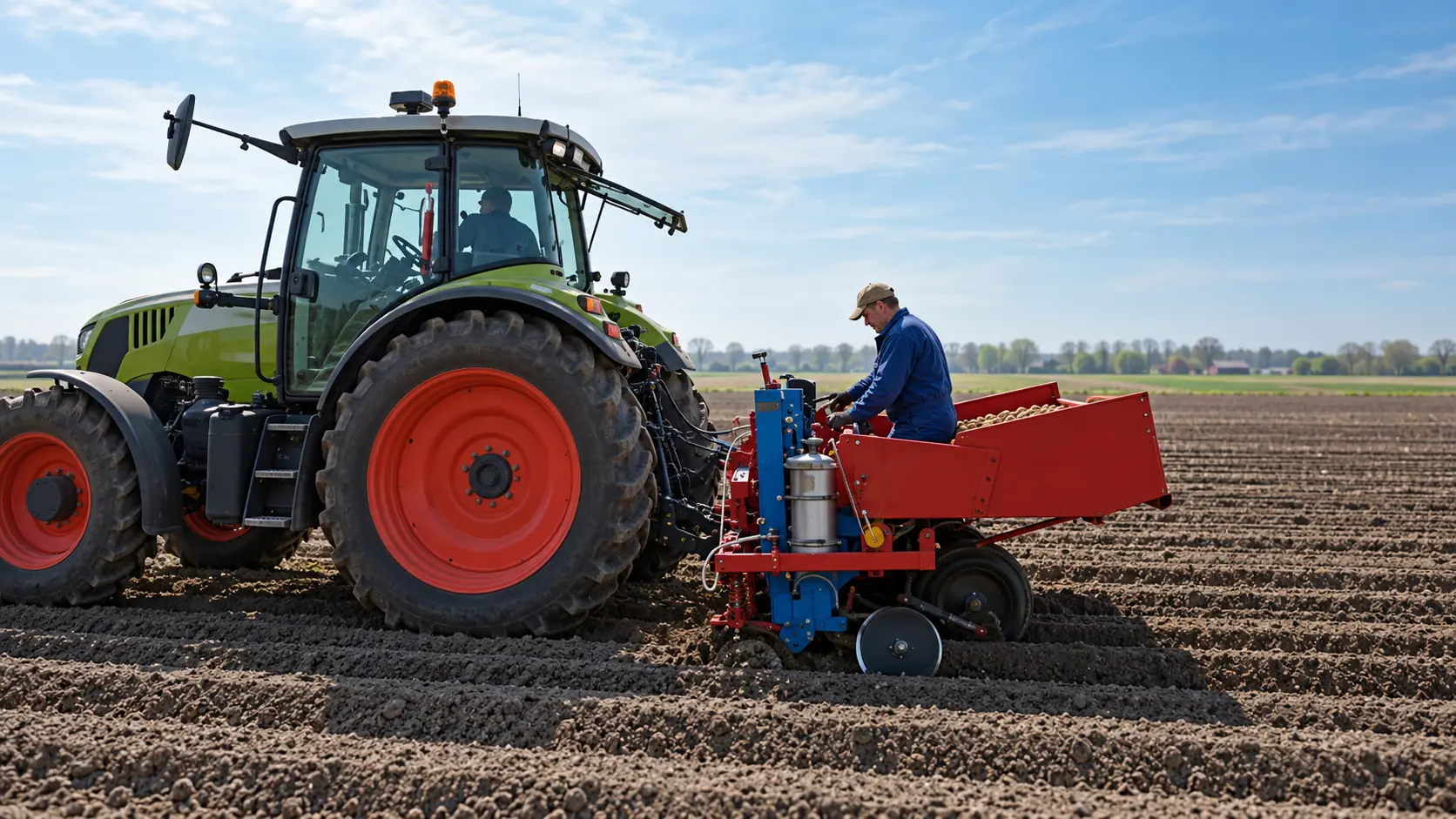
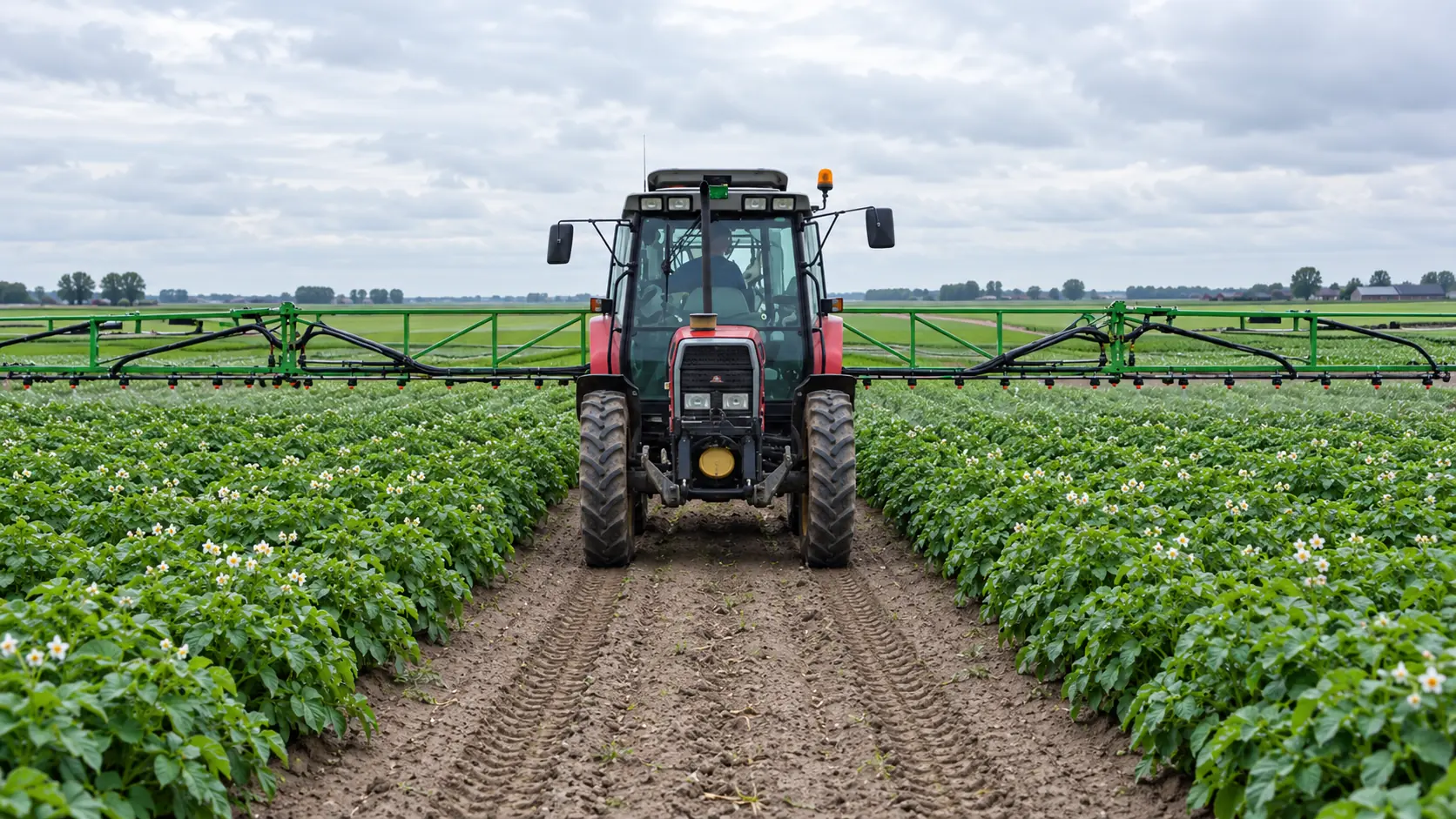
The programme was applied at defined moments in the crop cycle.
Herbali and Herbali – Boost were applied twice. Herbali – Plant Care started on 12 June and was repeated weekly until haulm destruction.
What the trial measured, and what SPNA concluded.
The figures below reproduce the report's results. They are not extrapolated beyond this 2012 trial.
SPNA concluded that Herbali had a positive effect on total crop yield, mainly through a higher tuber number.
Reported difference between untreated and Herbali for the total crop.
Average trial yield and the reported deliverable seed-potato size fraction.
Herbali alone: 49.5 t/ha. Untreated: 47.0 t/ha. SPNA concluded that adding Herbali – Boost negated the Herbali effect in many cases.
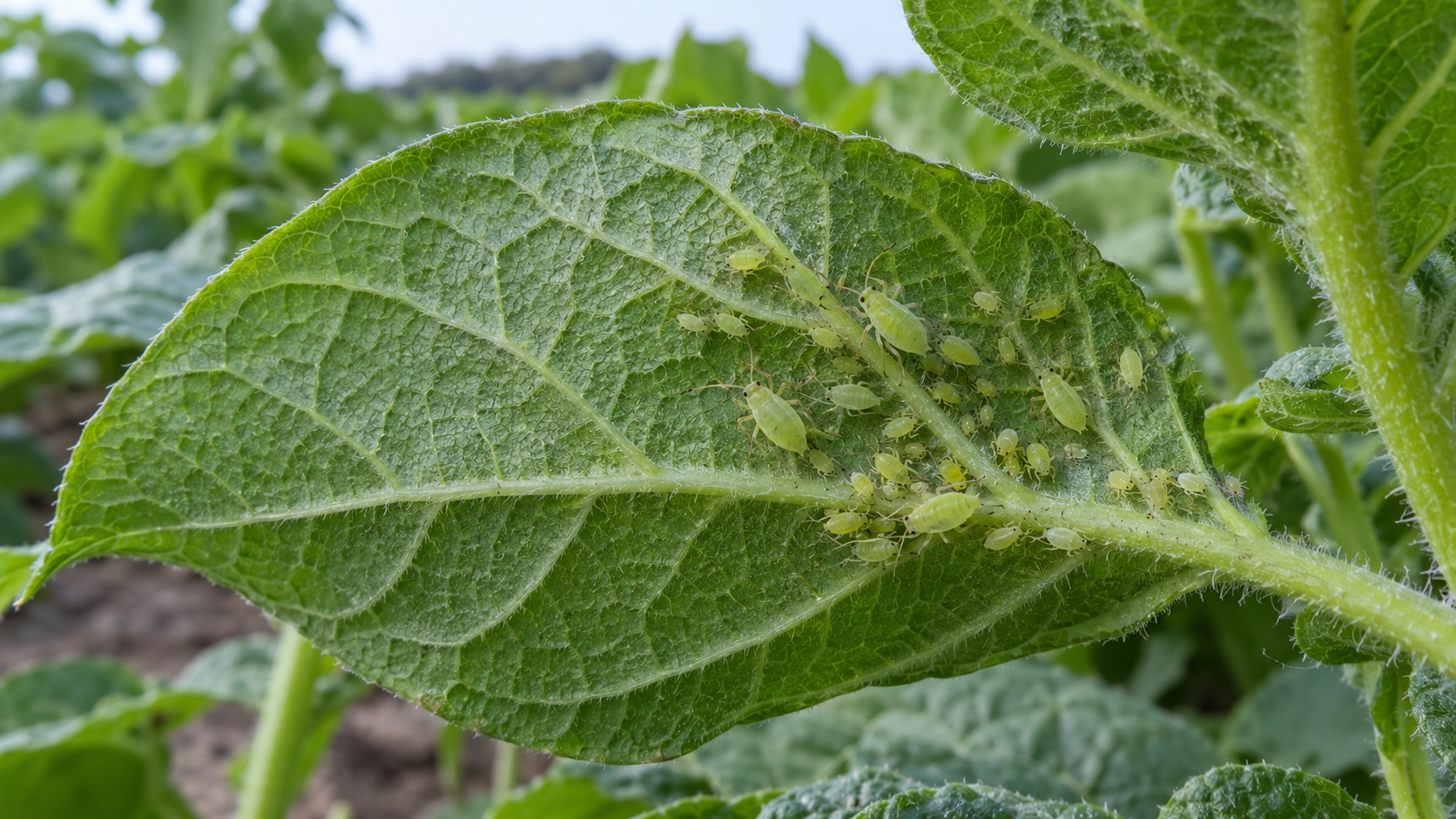
The aphid pressure in the field was too low. SPNA explicitly states that no conclusion could be drawn from this trial about the effect of Herbali – Plant Care on aphid presence.
The treatment means reported by SPNA.
Values below are transcribed from Tables 1, 3 and 4 of report 116. GKG is the average tuber weight.
Herbali treatments
| Treatment | Total yield t/ha | Total no./m | Total GKG g | 28–55 yield t/ha | 28–55 no./m | 28–55 GKG g |
|---|---|---|---|---|---|---|
| Untreated | 47.0 | 36.8 | 96 | 37.3 | 31.1 | 90 |
| Herbali | 49.5 | 39.5 | 94 | 39.5 | 33.3 | 89 |
| Herbali + Herbali – Boost | 47.0 | 37.0 | 93 | 38.0 | 32.1 | 89 |
| LSD (P=0.05) | 2.3 | 2.0 | 2.8 | 3.4 | 2.4 | 2.8 |
Herbali – Plant Care × fertilisation
| Fertilisation / Plant Care | Total yield t/ha | Total no./m | Total GKG g | 28–55 yield t/ha | 28–55 no./m | 28–55 GKG g |
|---|---|---|---|---|---|---|
| Suboptimal / no | 47.1 | 38.8 | 91 | 39.4 | 33.7 | 88 |
| Suboptimal / yes | 48.5 | 40.1 | 91 | 40.7 | 34.8 | 88 |
| Optimal / no | 47.1 | 36.8 | 96 | 37.6 | 31.2 | 90 |
| Optimal / yes | 47.2 | 35.3 | 100 | 35.3 | 29.0 | 92 |
| LSD (P=0.05) | 2.6 | 2.8 | 3.3 | 3.9 | 3.4 | 3.2 |
Aphids per 20 compound leaves
| Observation | 15 Jun | 22 Jun | 29 Jun | 6 Jul | 13 Jul | 20 Jul | 25 Jul |
|---|---|---|---|---|---|---|---|
| Trial mean | 0 | 0 | 0.4 | 1.5 | 4.0 | 1.1 | 2.7 |
Significance notation used in the source report: *** P≤0.001; ** 0.001≤P≤0.01; * 0.01≤P≤0.05; ~ 0.05≤P≤0.10; – P>0.10.
Emergence was counted on 30 May. SPNA described the trial as homogeneous and reported no treatment-related irregularities. Late in the season, visible stand differences were associated with the fertilisation levels.
Section 3.3 reports an average of 15.3 stems per metre of row, while section 4.3 states more than 20 stems per metre. Because the source is internally inconsistent, this page does not present either figure as a resolved result.
The observation stays connected to the protocol.
The trial context, observation method and reported outcome are presented together. Contextual field visuals support the narrative, while the measurements remain those documented in SPNA report 116.
Defined field context
Kollumerwaard, seed potato variety Spunta, winter wheat as the preceding crop and a documented planting date of 2 May 2012.
Repeatable observation
Measurements were linked to fixed plots, treatment factors and observation moments, allowing the reported outcomes to remain attached to their trial architecture.
Aphids were counted two days after each Herbali – Plant Care application.
Per plot, 20 compound leaves from the second-highest leaf layer were collected and the aphids present were counted. The observed field pressure remained too low for an efficacy conclusion.
Four findings, kept in the context of this trial.
The report describes +1.4 t/ha total crop yield, +1.3 t/ha in 28–55 mm, +1.3 tubers/m total and +1.1 tubers/m in 28–55 mm, with no effect on grading.
SPNA reported no effect on total crop yield, but an effect on 28–55 mm yield. With Herbali – Plant Care, significantly more tubers were formed under suboptimal than under optimal fertilisation.
SPNA concluded a positive effect on total crop yield of +2.5 t/ha, mainly caused by +2.7 tubers per metre of row.
The report states that adding Herbali – Boost negated the Herbali effect in many cases.